The DCP Team
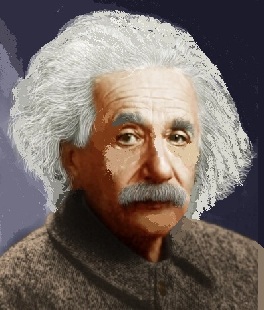
Einstein was a great theoretical physicist and Nobel Prize laureate. He is famous for developing the theory of relativity and E = mc2. He proposed dis-continuum physics (DCP) in 1954, approximately a year before his death in 1955.
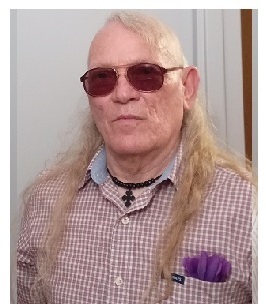
Taylor is an independent theoretical physics researcher, amateur astronomer, writer, artist, and former bass guitarist. He has worked on the conceptual foundations of dis-continuum physics (DCP) since the early 1980s.

Iyer is a physicist, receiving a Ph.D. from Case Western Reserve University in 1985. He has published papers in material physics and theoretical physics. He began working with Taylor in 2021 to advance dis-continuum physics (DCP).
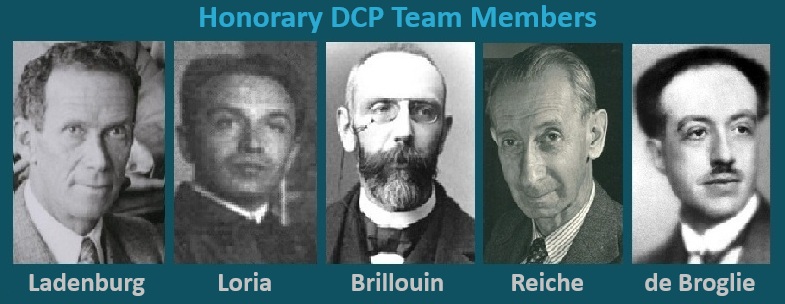
In 1908, Rudolf Ladenburg and Stanislaw Loria experimentally studied spectral lines, anomalous dispersion, and the relationship between experimental results and the structure of the interactions between light and matter [1-3]. In 1912, in the proceedings of the first Solvay conference, Marcel Brillouin concluded that physicist must introduce a discontinuity, something that changes in jumps, into their physical and chemical ideas [4-6]. In 1914 Ladenburg found a classical formula to determine the amount of energy emitted by dispersion electrons per unit volume and time, with this quantity called current density [3,7]. In 1921, Ladenburg found a formula for calculating the quantum current density in Einstein’s paper on quantum radiation [8,9]. Ladenburg forced his 1914 classical formula and his 1921 quantum formula to be equal [8,9]. The end result was, in 1921, Ladenburg found another formula, and it related the number density of dispersion electrons, that produce the dispersion of light, of a classical model with the quantum quantities of Einstein’s transition probabilities, for quantum jumping electrons, and Bohr’s atomic model, that used quantum jumping electrons [8,9]. In 1923, using Ladenburg’s 1921 formula, Ladenburg and Fritz Reiche published a paper on their discovery of substitute oscillators, also called Ladenburg – Reiche oscillators (L-R oscillators) [9,10]. The mathematics of Ladenburg and Reiche for describing the atom with all its energy levels is similar to the mathematics of a collection of classical oscillators [9]. The work by Ladenburg and Loria, and by Ladenburg and Reiche, and the conclusion by Brillouin, which was made before Bohr proposed his atomic model, were used to demonstrate that discontinuum physics (DCP) was hiding within the foundations of quantum mechanics. In 1924 - 1925 Louis de Broglie introduced his relation for which a mass particle has the wave aspect of wavelength when it has momentum [11]. De Broglie’s relation is used in DCP to demonstrate that Schrodinger’s quantum wave mechanics is not fundamental.
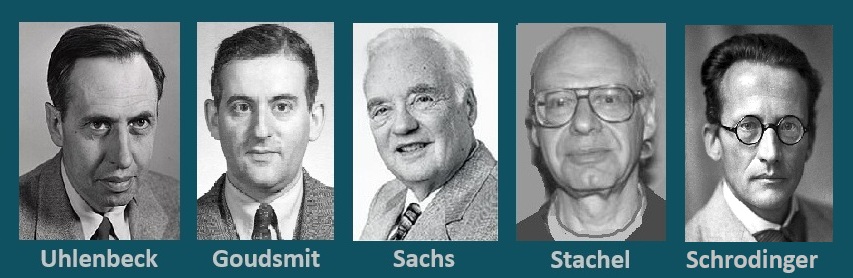
In 1925 George Uhlenbeck and Samuel Goudsmit developed the concept of electron spin, a literally spinning electron, for Pauli’s two-valuedness [12,13]. In 1993 John Stachel wrote an article about Einstein’s and his opposing ideas on reality in Science in Context [14,15]. Stachel described these opposing ideas in terms of two Einsteins, one who believed reality must be based on the continuum concept, and “another Einstein” who believed reality cannot be based on the continuum concept, with Stachel using Einstein’s three 1954 letters about a discontinuum physics to describe this other Einstein, with this other Einstein having the last word about Einstein’s view on reality [14,15]. In 1986 Mendel Sachs published on how quantum mechanics can be obtained from general relativity, and by 1999 he developed the unified field theory that Einstein attempted to develop [16,17]. Schrödinger, E. (1935). In 1935 Schrodinger published a paper in which he sided with Einstein against the Copenhagen version of quantum mechanics that was developed by Bohr and Heisenberg [18]. Additionally, Schrodinger’s 1926 quantum wave mechanics used the continuum concept as fundamental, which was in line with Einstein’s pre 1954 belief that the continuum concept was fundamental, but, as discovered in 2026 in the first DCP math paper, the use of the imaginary number i in Schrodinger’s wave equation leads to the discontinuum concept being fundamental, not the continuum concept, which is in line with Einstein’s 1954 speculations that the continuum concept, along with space and rime and differential quotients, having to be discarded as fundamental [14,15,18,19,20].
References
[1] A R. Ladenburg and S. Loria, Physikalische Zeitschrift Vol. 9, No. 24, (1908). pp. 875 - 878.
[2] S. Loria, Ann. der physic Vol. 335, Iss. 12, (1909). Pp. 240 – 256.
[3] See the YouTube video “Optical dispersion becomes quantum” by Dr. Jorge S. Diaz.
[4] M. J. Klein, Science Vol. 148, No. 3667. (1965). p. 178.
[5] J. L. Heilbron and T. S. Kuhn, Physical Sciences, Vol. 1 (1969), pp. vi, 211-290.
[6] E. Solvary, P. Langevin, M. de Broglie, and A. Einstein, The Theory of Radiation and Quanta: Reports and Discussions of the Meeting Held in Brussels, October 30-November 3, 1911, under the auspices of M.E. Solvay (Gauthier-Villars, Paris, France, 1911).
[7] R. Ladenburg, About the number of atoms involved in the emission of spectral lines (Thirty-second Annual Report of the Silesian Society for National Culture, Breslau, Poland. 1914). p. 10.
[8] R. Ladenburg, Journal of Physics, Vol. 4, Iss. 4. (1921).
[9] See the YouTube video “The virtual orchestra of quantum mechanics” by Dr. Jorge S. Diaz.
[10] Ladenburg, R., and F. Reiche, Die Naturwissenschaften 11, 27 (1923). pp. 584–598.
[11] L. de Broglie, Ann. de Physique 3, 22 (1925).
[12] Domenico Giulini Electron Spin or “Classically Non-Describable Two-Valuedness”
arXiv:0710.3128v1 [physics.hist-ph] 16 Oct 2007. pp. 3-5, and 11. https://arxiv.org/pdf/0710.3128.
[13] Samuel A. Goudsmit and George E. Uhlenbeck. Spinning electrons and the structure of spectra. Nature, 117:264–265, 1926.
[14] J. Stachel, Science in Context, Vol. 6, 1993). pp. 275-290.
[15] J. Stachel, Einstein from ‘B’ to ‘Z’ (Birkhauser, Boston, MA. 2002). pp.141-154.
[16] M. Sachs, Quantum Mechanics from General Relativity, Reidel, Dordrecht, 1986.
[17] M. Sachs, Physics of the Universe, Imperial College Press, London, UK. pp. 27-36, and 88-89.
[18] Schrödinger, E. Die gegenwärtige Situation in der Quantenmechanik. Naturwissenschaften 23, 807–812 (1935). https://doi.org/10.1007/BF01491891. An English translation is at https://materias.df.uba.ar/f4Aa2012c2/files/2012/08/Schrod_cat.pdf.
[19] E. Schrodinger, The Physical Review, Second Series, Vol. 28, No. 6 (1926). pp. 1049 - 1070.
[20] 1 DCP MATH 1
Beginnings of Dis-continuum Physics (DCP)
Einstein and Rosen (ER) coauthored “The Particle Problem in the General Theory of Relativity” (ER paper) and published it in 1935.1 ER were troubled by the fact theoretical physics did not provide a unified foundation for the theoretical treatment of all phenomena.1 There was a general relativistic theory for macroscopic phenomena and quantum theory for a large number of atomic and quantum phenomena.1 ER were also troubled by the singularity problem in general relativity (GR).1 ER wanted to resolve these troublesome issues with a relativistic theory, namely the ER paper.1 ER claimed success concerning the atomistic character of matter, and claimed some success concerning resolving the singularity problem, and they thought continued work might account for quantum phenomena.1 Einstein was not able to account for quantum phenomena with a relativistic theory. He knew if physics could not be based on the continuous field concept then nothing would remain of his relativistic theory or of contemporary physics.2 In 1954 Einstein admitted he had not been able to account for the atomistic character of nature,2 and he speculated the way forward in physics was to discard the continuum concept, along with space and time and differential quotients ,2 and he proposed a dis-continuum physics but did not know how to proceed with it.2
In the late 1970s Emory Taylor became an amateur astronomer. By the early 1980s Taylor realized the importance of the ER paper and began working on discontinuum geometry and conceptual dis-continuum physics (DCP). Taylor was led to the discontinuum through a series of dreams in which he was visited by Hypatia. In the first dream, a naked woman repeatedly called his name and gently shook him awake. He did not recognize her. She said, “Avenge me, Emory.” This was unusual because no one called him by his first name back then, and her lips were not synchronized with her words. She walked toward his bedroom door. Sitting up, Emory noticed a deep pool of water. She dove in and swam underwater to three granite steps in front of his bedroom door. On the first step she again said, with lips and words out of sync, “Avenge me, Emory.” On the second step she leaned toward him, and he heard whispering in his ears, “Descartes. Do not forget.” On the top step the skin fell off her naked body. Skinless, she again said, with lips and words out of sync, “Avenge me, Emory.” The door opened, white light shown around her, and the skin was back on her beautiful, naked body. A storm had developed above them. Lightning and thunder erupted, and rain poured down as she said, “Hypatia.” As she was disappearing into the white light, Emory again heard whispering in his ears, “I am Hypatia. Avenge me, Emory. Do not forget. Descartes.” The door closed. Emory awoke.
It was Descartes’ use of a discontinuum for drawing a complex geometrical curve that sent Emory down the path to discontinuum geometry. In the early 1990s Emory heard about the Bruno insight, a generalization of Bruno’s cosmology with the religious aspects replaced with physical aspects and nonphysical aspects. Emory paid little attention to it until Hypatia visited again in a dream, making him aware a discontinuum was at the heart of the Bruno insight. In the early 2000s Emory became aware of Einstein’s 1954 letters to Michele Besso and H. S. Joachim and David Bohm, in which Einstein confessed he had not been able to account for the atomistic character of nature, and he speculated the way forward in physics was to discard the continuum concept, along with space and time, and differential quotients, and proposed a dis-continuum physics.
By 2018 Emory’s attempts to conceptualize DCP were nearly completed and Jennifer Scheer, a math instructor at Northeast Community College in Norfolk, Nebraska (USA), became a sounding-board. In the same time period, Emory read Einstein’s 1961 book3 about relativity that was only sold in the USA. In that book Emory discovered that Einstein, without realizing it, introduced a quantized two-dimensional discontinuum geometry (Q2DDG, also called Einstein's quantized geometry) and inadvertently falsified relativity. This meant the foundations of physics do not now (and never did) include a fundamentally sound relativistic theory to account for macroscopic phenomena, and relativity must be a first approximation of a more fundamental discontinuum theory based on a Q2DDG or an algebraic version of it.4 Emory then published “Falsification of Einstein’s relativity” in the peer review physics journal Physics Essays in 2021.4
Dr. Iyer replied to an email sent to him by Emory on or about 14 July 2021. Emory had emailed 100 physicists from a list he compiled while reading physics papers, mostly at arxiv.org. Emory’s letter included the quote from Einstein’s 1954 letter to David Bohm about Einstein not having any idea about what elementary concepts would replace the continuum concept and space and time. Emory claimed to know the elementary concepts but did not know the algebraic version needed to replace relativity. Emory inquired, “I want to know if you will write the algebraic version and then we publish together.” Only a few (four or five) physicists replied. Iyer was one of them and informed Emory about the paper “Theory of a super luminous vacuum quanta as the fabric of Space” he coauthored with Emmanouil Markoulakis. Iyer wanted to confirm the 1954 quotes by Einstein and ask Emory to provide the source, which Emory did. Iyer then joined the struggle to bring Einstein’s discontinuum theory to fruition. This led to the publication of several peer reviewed papers about DCP in Physics Essays5-14. The second was “Rethinking special relativity, spacetime, and proposing a discontinuum”, which was coauthored by Emory and Iyer, on 25 February 2022 in Physics Essays.6 Its Abstract: "Following Einstein’s 1954 speculation that it is possible physics is based on a discontinuum theory, and that the continuum concept along with space and time must be discarded, the discovery of a new interpretation of the constancy of the speed of light leads to the discovery of three systems of measure used by inertial observers, which leads to rethinking the concept of spacetime and re-designing the foundations of physics."5
References
1A. Einstein and N. Rosen, Phys. Rev. 48, 73 (1935).
2J. Stachel, Einstein from ’B’ to ’Z (Springer Science & Business Media, 2001), Vol. 9, pp. 150–152.
3A. Einstein, Relativity: The Special and General Theory (Crown Publishers, Inc., New York, 1961), pp. 55, 82–90, 94–5, 102, 142–144.
4E. Taylor. Phys Essays 34, 4 (2021).
5E. Taylor, and R. Iyer, Physics Essays 35, 1 (2022). Pages 55-60.
http://dx.doi.org/10.4006/0836-1398-35.1.55.
6E. Taylor, Physics Essays 35, 3 (2022). Pages 250-251.
http://dx.doi.org/10.4006/0836-1398-35.3.250.
7E. Taylor, and R. Iyer, Physics Essays 35, 4 (2022). Pages 395-397.
http://dx.doi.org/10.4006/0836-1398-35.4.395.
8E. Taylor, and R. Iyer, Physics Essays 35, 4 (2022). Pages 321-321.
http://dx.doi.org/10.4006/0836-1398-35.4.321.
9E. Taylor, and R. Iyer, Physics Essays 36, 3 (2023). pages 265-268.
http://dx.doi.org/10.4006/0836-1398-35.4.265.
10E. Taylor, and R. Iyer, Physics Essays 36, 4 (2023). pages 358-360.
http://dx.doi.org/10.4006/0836-1398-36.4.358.
11E. Taylor, and R. Iyer, Physics Essays 36, 4 (2023). pages 416-421.
http://dx.doi.org/10.4006/0836-1398-36.4.416.
12E. Taylor, and R. Iyer, Physics Essays 37, 1 (2024). pages 71-73.
http://dx.doi.org/10.4006/0836-1398-37.1.71
13E. Taylor, and R. Iyer, Physics Essays 37, 2 (2024). pages 165-168.
http://dx.doi.org/10.4006/0836-1398-37.2.165
14E. Taylor, and R. Iyer, Physics Essays 37, 4 (2024). pages pp. 316-319.
http://dx.doi.org/10.4006/0836-1398-37.4.316.